
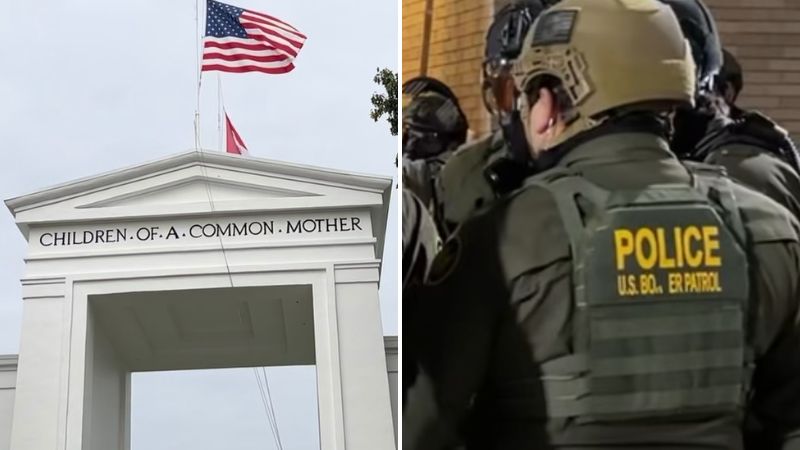
The incident occurred in the morning hours at the intersection of 4th Street and A Street, a couple of hundred yards from the famous Peace Arch.

The incident occurred in the morning hours at the intersection of 4th Street and A Street, a couple of hundred yards from the famous Peace Arch. Agents with the Federal Bureau of Investigation (FBI) are on scene investigating this case.
CBP Commissioner Rodney Scott told The Post Millennial in a statement: "On the morning of June 16, 2026, a US Border Patrol agent discharged his service weapon during an encounter with a subject in Blaine, Washington, near the Canadian border."
"The subject was injured and received medical treatment. The Border Patrol agent was not injured. A firearm was recovered at the scene," Rodney continued. "The Whatcom County Sheriff's Office, City of Blaine Police Department, CBP's Office of Professional Responsibility (OPR), and the FBI responded to the scene. The FBI is leading the criminal investigation with CBP OPR performing a use of force review of the incident."
Additional details surrounding the subject, such as whether the individual was targeted for an immigration enforcement operation, have not yet been provided.
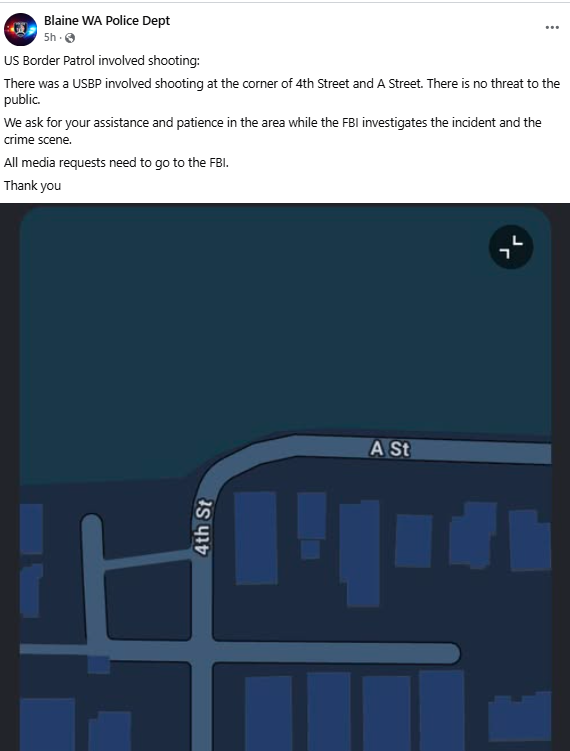
The Blaine Police Department said on Facebook that "there is no threat to the public."
This comes after Washington state officials in April blocked federal agents with the Department of Homeland Security (DHS), including CBP and US Immigration and Customs Enforcement (ICE), from accessing state databases used for routine law enforcement purposes, such as running license plates and driver's licenses.
Federal officials warned at the time that the effort, aimed at impeding immigration enforcement and protecting illegal immigrants, could put the lives of Border Patrol and ICE agents at risk.
The new restrictions mean that federal agents can no longer determine whether a vehicle's owner has outstanding warrants or poses a public safety risk. Officers now must approach vehicles "blind" with little to no information, placing them in direct "danger," a situation that could potentially get them killed, First Assistant US Attorney Neil Floyd for the Western District of Washington previously warned.
The move significantly impacts CBP officers patrolling near the border or conducting stops, as they are now forced to operate with reduced information. Previously, automated license plate scans allowed Border Patrol agents to quickly verify vehicle registration and match it to the driver's license.
Without this, officers must manually check details, leading to longer lines caused by a more tedious process. Floyd expressed his apprehension regarding the safety of CBP officers who are conducting surveillance in hotbed areas for human smuggling, which are frequently operated under the direction of the cartels, which are US-designated foreign terrorist organizations.
This report will be updated when subject information has been made available.
Powered by The Post Millennial CMS™ Comments
Join and support independent free thinkers!
We’re independent and can’t be cancelled. The establishment media is increasingly dedicated to divisive cancel culture, corporate wokeism, and political correctness, all while covering up corruption from the corridors of power. The need for fact-based journalism and thoughtful analysis has never been greater. When you support The Post Millennial, you support freedom of the press at a time when it's under direct attack. Join the ranks of independent, free thinkers by supporting us today for as little as $1.
Remind me next month
To find out what personal data we collect and how we use it, please visit our Privacy Policy






Comments