
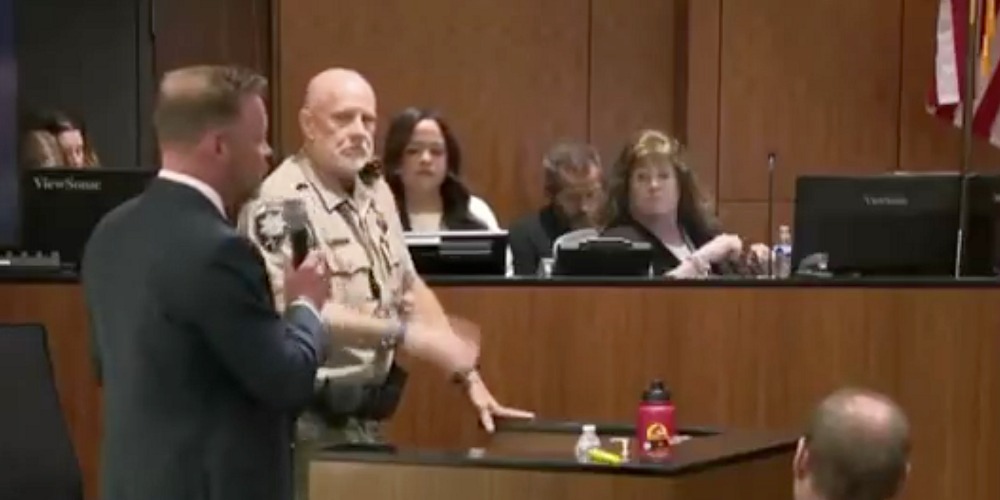
"The people in the gallery have the right to see that."

In the preliminary hearing of Tyler Robinson on Monday, attorneys representing media parties urged that exhibits being shown in the courtroom be shown to the entire room, not just on monitors for attorneys and the judge.
The statement came amid the questioning of witness David Hull, a former State Bureau of Investigations investigator. The prosecution sought to admit video taken by a woman at the scene, have it be published within the courtroom, and have it "be published publicly at large."
Kathy Nester, representing Tyler Robinson, objected to the video’s admission on the grounds "that it’s not properly authenticated," with the woman who filmed it not being present in the courtroom. She also argued that the video should not be admitted because "we feel like this would really impinge on Mr. Robinson’s right to a fair trial, and so we’re asking it not to be published, and certainly, if the court does publish it, that it’s certainly not filmed."
She also argued that under Utah Code of Judicial Administration Rule 4-202.02, victims of a crime are designated as private court records, and everyone who was in the audience that day is a potential victim. Graf ultimately ruled that the video could be played in the courtroom, but could not be captured on cameras.
An attorney representing media parties stated, "It sounds like the classification rule that Ms Nester is citing, and that your honor was just reading, is not about in-court exhibits. That is classification for records in the court file. So it is a fundamentally different thing when we are in a public proceeding and the state is presenting an exhibit that you are relying on, and the public is being denied the chance to see it.
"That is a fundamental violation of the right of access, and it can—it's a qualified right, and I recognize that, but that's not the ruling that you just made, you're just ruling based on the code of judicial administration, which doesn't have anything to do with when something is presented in a public proceeding."
He said that the rule cited by Nester relates to "when it is presented in open court as an exhibit for you to rely on, the public is entitled to see what you're seeing, so that they can understand what your decision making process is, and so this one, it doesn't sound like this sounds pretty anodyne to me, you know, it’s just not even depicting the shooting."
"I just wanted to clarify, the classification issue about when, you know, we’re filing things with the court and we say like, this, maybe we file a motion to classify. That’s not the decision you’re making today. The decision you're making today is the state is presenting something to you, you're watching it, you're making a decision based on it, and the people in the gallery have the right to see that, whether you allow EMC of it is a different question, and we think that the EMC should be allowed too, for reasons that we briefed, but I do think that it at least should be published at the courtroom."
Powered by The Post Millennial CMS™ Comments
Join and support independent free thinkers!
We’re independent and can’t be cancelled. The establishment media is increasingly dedicated to divisive cancel culture, corporate wokeism, and political correctness, all while covering up corruption from the corridors of power. The need for fact-based journalism and thoughtful analysis has never been greater. When you support The Post Millennial, you support freedom of the press at a time when it's under direct attack. Join the ranks of independent, free thinkers by supporting us today for as little as $1.
Remind me next month
To find out what personal data we collect and how we use it, please visit our Privacy Policy





Comments