
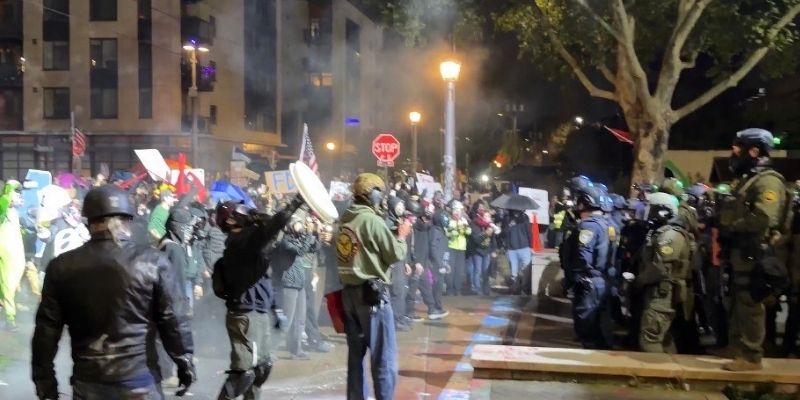
DOJ Deputy Assistant Attorney General Eric Hamilton asserted that the president holds the “full power” to federalize the National Guard, a decision not up to judicial review.

The state of Oregon and the City of Portland, the plaintiffs in the case of Oregon v Trump, et al, argue the move constitutes an unlawful overreach into local affairs, while the defense maintains it was a necessary response to ongoing violence directed at the ICE facility and federal agents, as well as justification under presidential authority.
In opening statements, DOJ Deputy Assistant Attorney General Eric Hamilton, representing the defendants – including Trump, Department of Homeland Security Secretary Kristi Noem, and Secretary of War Pete Hegseth – asserted that the president holds the “full power” to federalize the National Guard, a decision not up to judicial review. He cited Supreme Court rulings and longstanding laws of the nation supported by Congress.
Hamilton described four months of “persistent violence” against federal agents and the ICE facility, arguing that the Department of Homeland Security (DHS) lacked the resources to sustain deployments from multiple federal agencies without disrupting core missions like Title 8 immigration enforcement efforts. He accused the Portland Police Bureau (PPB) of repeatedly denying aid to federal officers, stating, “Federalization of guardsmen should not have to wait for a rebellion to materialize.
In contrast, Portland Senior Deputy City Attorney Caroline Turco, speaking for the plaintiffs, framed the deployment as government overreach. “This is a nation of Constitutional law, not martial law,” she declared, claiming that demonstrations have been calm and non-violent since mid-June, with the vast majority involving protected First Amendment activities. However, that claim can be refuted by months of evidence captured by The Post Millennial. Turco contended that DHS could allocate more resources without invoking the Guard, avoiding what she called an “escalatory” military presence.
The case stems from the ongoing 24-hour Antifa-affiliated occupation outside the ICE facility, which began on June 7. Federal authorities have reported persistent unlawful acts committed by protesters, including repeated assaults on federal agents, arson attacks, depredation of government property, trespass, and blocking vehicles from entering and exiting the facility.
Portland Police removed its presence in late June, resulting in near-nightly clashes between federal agents and unlawful demonstrators, primarily as a result of the bureau's documented failure and refusal to respond to criminal activity committed by protesters outside the ICE facility, which is under PPB's jurisdiction. The scene in Portland's Southwest waterfront district has been plagued with plumes of smoke-filled tear gas, as federal officials continuously deploy less lethal crowd control weapons to clear disruptive agitators. As a result of the violence and lack of local intervention, President Trump ordered the National Guard to be deployed.
Portland Police Take the Stand: blame federal agents for violent protest action and assert PPB response is limited due to sanctuary and state laws.
PPB Commander Franz Shoening testified that the bureau shifted to a passive “watch model” on June 25 after having a full team on the ground to respond to protest activity beginning June 11. He said the shift was due to smaller crowd sizes and officers observing limited criminal activity.
This means that Portland Police had zero ground presence from June 26 until the bureau decided to return to the area after President Trump ordered the National Guard to be deployed in late September. While PPB had no presence for several months, as witnessed firsthand by The Post Millennial, federal authorities made over 100 arrests for offenses committed during Antifa-related direct actions outside the ICE facility.
Shoening further contended that federal officers were primarily responsible for any escalation of violence at protests. He squarely blamed ICE and DHS Federal Protective Service (FPS) agents for inflaming tensions, accusing them of “unlawful” use of crowd control munitions like tear gas and pepper balls to disperse crowds. He cited incidents on October 8 and October 18 (during the “No Kings” protest), alleging federal officers deployed munitions without provocation - such as a single round “bounced back” at them on October 18, which resulted in federal agents unleashing a flurry of less lethal munitions to disperse the crowd of hundreds blocking vehicles from exiting the driveway.
However, video evidence captured by The Post Millennial and other journalists on the ground appears to discredit Shoening’s testimony. Footage shows several protesters hurling deployed munitions at federal agents throughout the day and night on October 18, which resulted in the heavy response by federal officers, DHS sources said.
The commander also testified that staffing issues and sanctuary policies, as well as a state statute that prohibits PPB from assisting other law enforcement agencies when crowd control munitions are deployed, have limited the Portland Police from responding to the area.
When pressed about why the Portland Police have failed to remove protesters blocking the roads to allow for vehicles to enter and exit the ICE facility, Shoening testified during cross-examination that officers cannot assist because they do not know if the vehicles are engaged in immigration enforcement, which would violate the sanctuary statute. Agitators blocking vehicles from entering and exiting the ICE facility have been a daily and nightly occurrence since June 7.
Furthermore, Shoening testified that PPB did not assist federal officers in arresting criminal protesters during the infamous June 14 “No Kings” riot, stating that the situation was too dangerous at the time. He dismissed the need for National Guard involvement, calling federal force "disproportionate to the level of criminal conduct" observed.
Subsequent witnesses reinforced the plaintiffs' narrative of local control. Oregon State Police Capt. Cameron Bailey testified that PPB only sought OSP assistance "less than a handful" of times over more than 100 days of protests, though a leaked email from an OSP officer criticized PPB for "giving up the area outside of ICE to criminal Antifa protesters." PPB Critical Incident Commander Brian Hughes described daily briefings portraying the situation as "handled," with interventions limited to "life-threatening" scenarios only. The DOJ cross-examination revealed that repeated federal requests for aid were ignored amid in-progress crimes, suggesting that PPB officers were not monitoring the area at all or were doing so inefficiently.
Day two of the three-day trial resumes on Thursday, with ICE, FPS, and Dept of War officials slated to take the stand.
Powered by The Post Millennial CMS™ Comments
Join and support independent free thinkers!
We’re independent and can’t be cancelled. The establishment media is increasingly dedicated to divisive cancel culture, corporate wokeism, and political correctness, all while covering up corruption from the corridors of power. The need for fact-based journalism and thoughtful analysis has never been greater. When you support The Post Millennial, you support freedom of the press at a time when it's under direct attack. Join the ranks of independent, free thinkers by supporting us today for as little as $1.
Remind me next month
To find out what personal data we collect and how we use it, please visit our Privacy Policy


Comments