
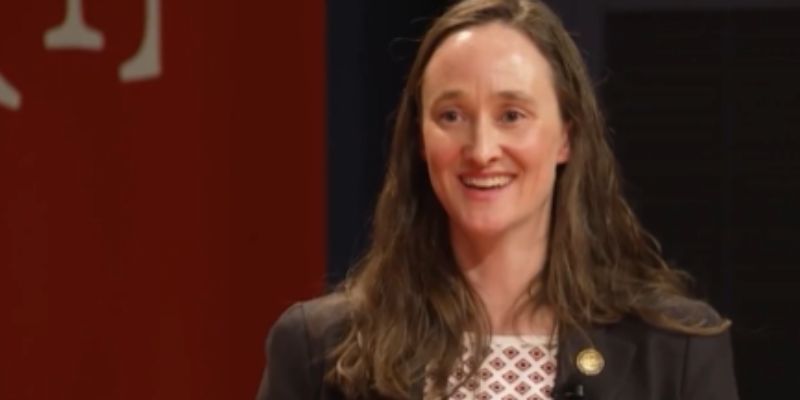
"It's not over."

Melinda Jacobson and her husband, Dale Osterud, launched the recall effort over Wilson’s handling of public safety, citing persistent crime in several Seattle neighborhoods, her handling of the deadly Bite of Seattle mass shooting, the departure of former Seattle Police Chief Shon Barnes, and the city's decision to deactivate surveillance cameras following the World Cup.
Jacobson and Osterud missed a court filing deadline Wednesday but appeared in King County Superior Court the following day unannounced, seeking to withdraw their recall charges. Jacobson said the couple had struggled to obtain legal representation before retaining an attorney Wednesday night who advised them to withdraw the current effort. The attorney was not present at Thursday's hearing.
Jacobson also said the couple had received new information concerning Wilson that they wanted additional time to investigate. "It's not over," Jacobson told reporters following the hearing. "(Wilson) has had nothing but a series of rash decisions and people are angry."
Jacobson later said she was not deterred by the possibility of sanctions threatened by Wilson's attorneys and suggested another announcement would come relatively soon. "It'll be sooner rather than later," she told local media. "I'm not deterred by the Mayor's attorney."
Under Washington law, a court must first determine whether recall charges are legally and factually sufficient and constitute "misfeasance, malfeasance, or violation of the oath of office." The couple had been scheduled to make that case at an Aug. 31 hearing. Had a judge approved the charges, recall supporters would have had 180 days to collect approximately 69,000 valid signatures from eligible Seattle voters. If King County Elections verified enough signatures, voters would then decide Wilson's fate in a recall election.
Jacobson and Osterud's original petition accused Wilson of failing to fulfill her responsibilities on public safety, pointing to conditions on Aurora Avenue, in Belltown, downtown, and in Seattle’s Chinatown-International District. It also cited the city's CCTV controversy and the fallout from the Bite of Seattle mass shooting. Three people were killed and five others were wounded in the July 26 Bite of Seattle shooting, including a two-year-old child. A 15-year-old was subsequently arrested, and authorities recovered a ghost gun. Another Glock equipped with an illegal switch remained unrecovered. The city also did not issue an emergency alert during the mass shooting.
Four days later, Barnes resigned as Seattle police chief amid the fallout from the shooting.
The violence came as Seattle continued struggling to rebuild its depleted police force. The Seattle Police Officers Guild has said the city needs approximately 1,250 deployable officers, while the department has roughly 927.
At the same time, Wilson's administration was already facing mounting criticism over Seattle's surveillance cameras. The city had activated its Stadium District CCTV system during the World Cup but shut the cameras off on July 7 after the tournament. Representatives of major Seattle venues subsequently urged city officials to reactivate the cameras and expand the network, arguing that they were an important public-safety tool. Wilson instead paused expansion of the system pending additional reviews. The Seattle City Council also redirected $250,000 that had been considered for surveillance-camera expansion toward "violence interruption" efforts.
The debate took on new urgency on Aug. 19 when gunfire erupted in Pioneer Square near First Avenue South and South King Street. Police recovered more than 30 shell casings from the scene while the city's CCTV cameras remained offline.
The Seattle Police Officers Guild blasted the situation as "deja vu," while businesses and venue operators renewed pressure on city leaders to restore and expand the camera network.
King County Superior Court Judge Patrick Oishi expressed frustration with the proceedings after Jacobson and Osterud missed their filing deadline and then attempted to withdraw the petition. Oishi said it would have been inappropriate for the court to communicate with the petitioners about the matter without Wilson's representatives present, leading to Thursday's hearing. "This whole process has been befuddling to the court," Oishi said.
Oishi ultimately granted the request, but did not rule on the legal sufficiency of the allegations or prevent the couple from bringing a future recall effort.
Wilson was represented by two personal attorneys, with the mayor reportedly paying for her defense rather than using city funds. Her attorneys had argued that the allegations against Wilson failed to satisfy Washington's demanding legal requirements for a recall, describing the charges as "legally and factually insufficient."
"There is no conduct alleged, or an articulated standard against which to judge that conduct amounting to cause for recall," Wilson attorney Dmitri Iglitzin wrote in court filings.
Following Thursday's withdrawal, Iglitzin called the effort frivolous and warned that Wilson could seek sanctions against Jacobson and Osterud if they revive the recall. "I am troubled to hear in open court some suggestion that they may just wait for another day and refile the same recall petition again," Iglitzin said.
"If it is not the end of this matter, there would have to be an effort to require the recall petitioners to take responsibility for their abuse of the process, the law, and this court's availability... a recall petition should not be used as or seen as a substitute for the normal process whereby election officials are elected at regularly scheduled elections."
Recall efforts face a steep legal hurdle in Washington, but Seattle has a long history of attempts to remove its mayors through the process. Only two Seattle mayors have actually been recalled by voters, and the last successful mayoral recall occurred 95 years ago.
In 1911, voters removed Mayor Hiram Gill, but Seattle voters returned him to the mayor's office in 1914 and reelected him in 1916. In 1931, voters overwhelmingly removed Mayor Frank Edwards in a July 1931 special election. No Seattle mayor has been successfully recalled since.
Mayor Wes Uhlman faced three separate recall attempts during the 1970s. More recently, an effort was launched to recall then-Seattle Mayor Jenny Durkan over the Seattle Police Department's response to the 2020 protests and riots following the death of George Floyd.
Former socialist Seattle City Councilwoman Kshama Sawant was one of the rare modern Seattle politicians whose recall effort actually reached voters. Sawant faced allegations that included allowing protesters into Seattle City Hall during COVID restrictions and using city resources to promote a ballot initiative. The Washington Supreme Court allowed several recall charges against her to proceed, ultimately leading to a December 2021 special election. Sawant defeated the recall by fewer than 400 votes.
Courts also rejected an attempt to recall then-Democratic Gov. Jay Inslee in 2022 over his use of emergency powers during the COVID-19 pandemic.
Jacobson and Osterud said the withdrawal may only be temporary. "It's not over."
Powered by The Post Millennial CMS™ Comments
Join and support independent free thinkers!
We’re independent and can’t be cancelled. The establishment media is increasingly dedicated to divisive cancel culture, corporate wokeism, and political correctness, all while covering up corruption from the corridors of power. The need for fact-based journalism and thoughtful analysis has never been greater. When you support The Post Millennial, you support freedom of the press at a time when it's under direct attack. Join the ranks of independent, free thinkers by supporting us today for as little as $1.
Remind me next month
To find out what personal data we collect and how we use it, please visit our Privacy Policy


Comments