
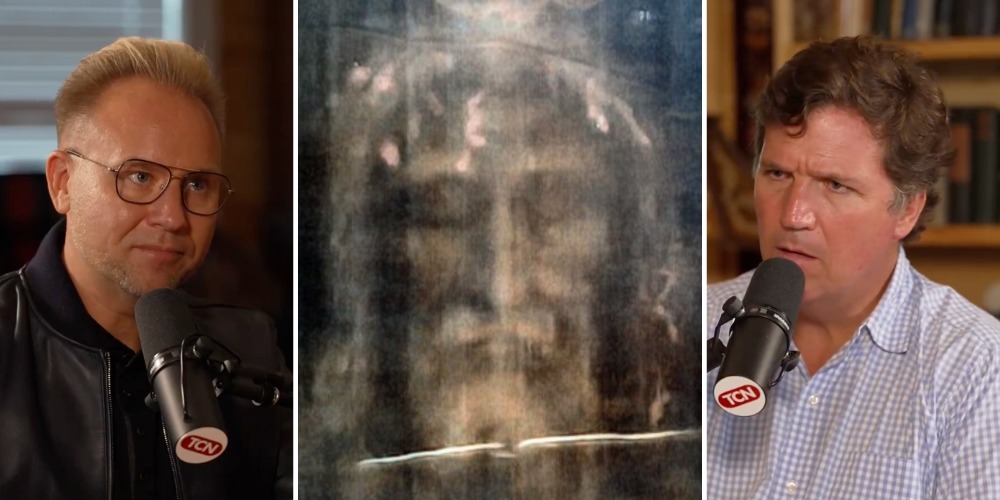
Johnston said the image records more than 700 separate injuries.

During a recent interview, biblical scholar Dr. Jeremiah Johnston told Tucker Carlson that mathematician Bruno Barberis of the University of Turin had calculated the odds at about one in 200 billion that the Shroud of Turin could have belonged to anyone other than Jesus of Nazareth.
The Shroud — a 14-foot strip of linen showing the faint image of a crucified man—has been at the center of decades of debate. In 1988, a radiocarbon test dated it between 1260 and 1390 AD, fueling claims that it was a medieval creation. Johnston pointed out, however, that the test did not use fabric from the original section but from a repaired corner. When Carlson asked, “So, not the real thing?” Johnston responded, “Correct.”
Barberis’s probability estimate considered several rare attributes, including the cloth’s dimensions, AB-type blood, and forensic details matching both pre- and post-mortem injuries consistent with crucifixion accounts in the Bible. Johnston described other findings that he said support authenticity, pollen from more than 50 plants, including some blooming only in Israel during April, and traces of Jerusalem-specific limestone and clay embedded in areas that would have made contact with the ground if a person carrying a heavy beam fell.
He also cited wounds corresponding to Roman crucifixion practices: nails through the wrists, scourge marks from lead-tipped whips, over 50 head injuries consistent with a crown of thorns, and a spear wound between ribs five and six matching the account in John 19:34: “But one of the soldiers pierced his side with a spear, and at once there came out blood and water.” Johnston said the image records more than 700 separate injuries.
Johnston explained that the image is only two microns thick and does not penetrate the cloth. He said the surface coloration appears on the outermost fibrils without pigment soaking through—something that could be scraped away with a razor blade. Research cited by Johnston points to a burst of energy around 34,000 billion watts for less than a billionth of a second as a possible cause, suggesting this might have happened at the moment of the Resurrection.
He noted that no paint, pigment, or dye has been found on the cloth, that the image has three-dimensional qualities, that the blood stains are older than the image, and that the microscopic oxidation resembles rapid sun-bleaching. Johnston added that modern attempts—even with excimer lasers—have not been able to replicate the effect without damaging the linen.
Calling the Shroud “the most lied about and misunderstood artifact in the world,” Johnston pointed to new testing, including wide-angle X-ray scattering in Rome, indicating the fabric could be around 2,000 years old based on the absence of vanillin. He also accused the British Museum of withholding important radiocarbon dating data for decades, suggesting the 1988 results were misleading.
For Johnston, the Shroud is both historical evidence and, as he put it, “the receipt of God’s gift.” Carlson closed the segment reflecting on the weight of what he had heard: “I’m being baffled right now.”
Powered by The Post Millennial CMS™ Comments
Join and support independent free thinkers!
We’re independent and can’t be cancelled. The establishment media is increasingly dedicated to divisive cancel culture, corporate wokeism, and political correctness, all while covering up corruption from the corridors of power. The need for fact-based journalism and thoughtful analysis has never been greater. When you support The Post Millennial, you support freedom of the press at a time when it's under direct attack. Join the ranks of independent, free thinkers by supporting us today for as little as $1.
Remind me next month
To find out what personal data we collect and how we use it, please visit our Privacy Policy







Comments