
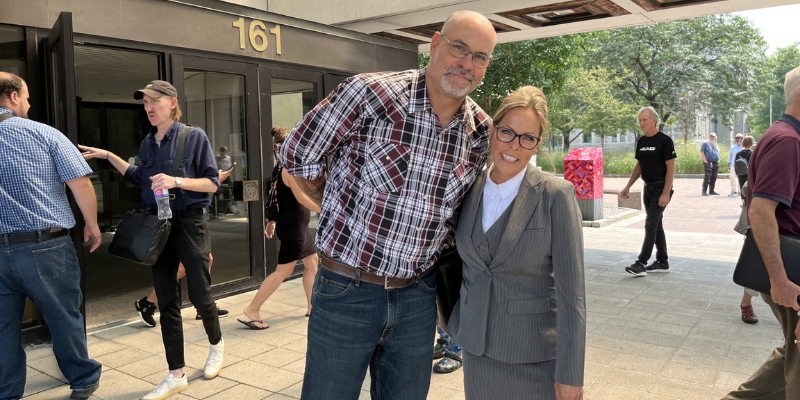
The judge said she relied heavily upon the Victims Impact Statements used by the prosecution during the trial as they paraded residents of Ottawa who claimed the protest negatively affected their lives.

Ontario Justice Heather Perkins-McVey sentenced Freedom Convoy organizers Chris Barber and Tamara Lich Tuesday to conditional sentences. Barber received a conditional sentence of house arrest for 12 months and a six month curfew. He must also perform 100 hours of community service. The judge made exceptions for employment purposes.
Lich received a 15.5 month conditional sentence, with 12 months house arrest and 3.5 months of curfew. The judge reduced the sentence because Lich had already served 74 days in jail.
Perkins-McVey rejected an absolute discharge for either Lich or Barber while noting that there was "an absence" of remorse from either. She also said eight or seven years in jail would be "unfit" for the conviction.
The judge had previously found the truckers' convoy leaders guilty on Apr. 3 on mischief charges.
It was the concluding day in a trial that lasted exactly two years and one month and is the longest mischief trial in Canadian history, according to Lawrence Greenspon, attorney for Lich. Many considered the trial to be an outrageous exercise in lawfare.
When asked if he approved of the sentence given to his client, Lich, lawyer Lawrence Greenspon told The Post Millennial, "The main objective was to make sure she didn't spend one more day in jail, and that was achieved. And so yes, in that sense, we're we are still very seriously considering an appeal of the conviction for mischief, but as far as the sentence goes, we're pleased that she is not going to be spending any more time in jail."
After dismissing one reporter's question about whether Lich felt any "remorse" over protesting Covid mandates, Greenspon told TPM that Lich might have actually saved lives by allowing helping to stop lockdowns and restrictions for the unvaccinated. "She may have, certainly she may have saved lives by by her advocacy. One thing we know is that there were many lives, many people that were inspired by her example, by what she said and and how she did it. There were lives that were changed as a result of her standing up on behalf of many thousands of Canadians, perhaps even tends of thousands of Canadians. So were lives saved? I don't know; but that may well have been."
Greenspon also said he is considering an appeal and is "concerned" about the potential chill on free speech and freedom of assembly the sentencing might have on peaceful protests in Canada. "I'm concerned that going forward, individuals who advocate peaceful assembly, and that's all that Tamara did, was talk about peaceful assembly and encourage people to come to Ottawa to assemble peacefully and lawfully. That's all she did. And if that becomes and at this point, it remains criminal, it's been found to be the offense of mischief. If that's allowed to stand, then I'm very concerned about the future of freedom of expression in this country, once you are appealing, we're seriously considering an appeal of the conviction for mischief."
Both Barber and Lich were key personalities of the Freedom Convoy that came to Ottawa in January 2022, when thousands of truckers descended upon Canada’s capital to protest the severe Covid mandates of the Liberal government of Prime Minister Justin Trudeau.
Perkins-McVey noted that both Barber and Lich had no criminal record and significant public support for their participation in a protest that was celebrated around the world. The judge said she was guided by “principles, including the requirement to consider aggravating and mitigating circumstances, parity among similar offenders and restraint in the deprivation of liberty and the consideration of all reasonable sanctions other than imprisonment, these principles reflect the presumption of restraint, particularly for first time offenders, and emphasize the importance of individualized sentencing. The court must consider not only the seriousness of the offense, but also the offender's personal circumstances.”
As a preamble to her decision Perkins-McVey summarized the arguments both the prosecution and defense, noting the gap between the two in terms of what they deemed to be fair sentencing.
“The parties could not be farther apart in their submissions or their perspectives regarding this case, much in the same way as this trial has highlighted the schisms,” Perkins-McVey said.
“Politics, though, has no place inside this courtroom and plays no role in the determination of what is a fair, just and appropriate sentence. In determining a fit and appropriate sentence, the court must consider the gravity of the offense, the degree of responsibility of each offender and the applicable sentencing principles under the Criminal Code, the court must also consider relevant jurisprudence to situate the present case within the broader framework of protest,” she continued.
Perkins-McVey said that the defense lawyer for Barber had noted that he “has already suffered. His personal bank account was frozen for two or three months under the Emergencies Act. He incurred $40,000 in travel expenses, attending court. He faces ongoing civil litigation, with a class action lawsuit seeking damages in the hundreds of millions. He was subject to strict bail conditions for over three years, including $100,000 bond.”
The judge said she relied heavily upon the Victims' Impact Statements used by the prosecution during the trial as they paraded residents of Ottawa who claimed the protest negatively affected their lives. She repeatedly referred to the noise of honking and the presence of diesel fumes in the downtown core during the protest.
“While the court recognizes that not all residents and businesses were negatively impacted, that some individuals and businesses and that some individuals and businesses expressed support for the protest, the preponderance of evidence demonstrates that the protest caused substantial harm to the quiet enjoyment of property, economic stability and public safety in downtown Ottawa.”
Powered by The Post Millennial CMS™ Comments
Join and support independent free thinkers!
We’re independent and can’t be cancelled. The establishment media is increasingly dedicated to divisive cancel culture, corporate wokeism, and political correctness, all while covering up corruption from the corridors of power. The need for fact-based journalism and thoughtful analysis has never been greater. When you support The Post Millennial, you support freedom of the press at a time when it's under direct attack. Join the ranks of independent, free thinkers by supporting us today for as little as $1.
Remind me next month
To find out what personal data we collect and how we use it, please visit our Privacy Policy


Comments