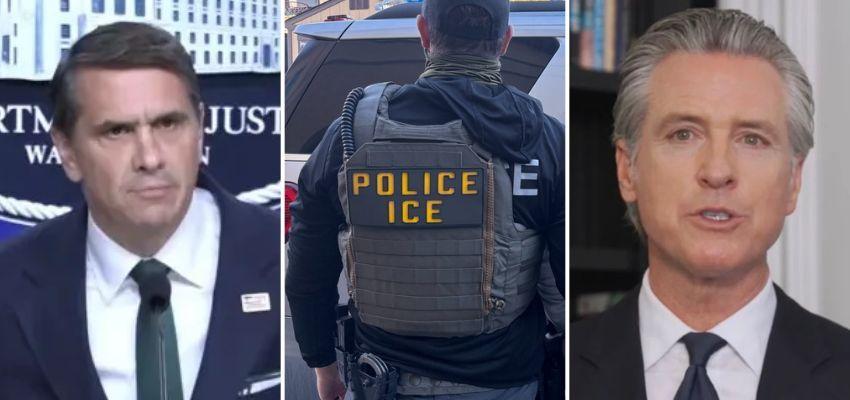
Trump fires cyber chief Sean Cairncross after outages hit airports, banks, NSA
Kirsten A. Davies, the Pentagon’s chief information officer, will reportedly take over in an acting capacity
Kirsten A. Davies, the Pentagon’s chief information officer, will reportedly take over in an acting capacity

National Cyber Director Sean Cairncross is out of a job as federal officials investigate a series of technology failures that grounded flights nationwide, disrupted online banking, and took a classified National Security Agency communications network offline. His departure date is not yet known.
A source close to the White House told Fox Business correspondent Edward Lawrence that President Donald Trump backed firing Cairncross because of concerns about his cybersecurity credentials. The same source said Kirsten A. Davies, the Pentagon’s chief information officer, would take over in an acting capacity. An administration official separately told Fox News that Cairncross did not want to spend another two years in the job.
Cairncross took office on August 4, 2025, two days after the Senate confirmed him. The national cyber director advises the president on cybersecurity and coordinates policy across the federal government. As the Pentagon’s chief information officer, Davies advises Defense Secretary Pete Hegseth on cybersecurity and information technology.
The global Microsoft outage, that began November 12 and disrupted Outlook, Teams and Copilot, continued into a second day. Microsoft traced the disruption to a problem introduced during an earlier network capacity upgrade that surfaced after a subsequent network change. The company said it found no evidence of malicious activity.
On November 13, a communications failure forced the Federal Aviation Administration to halt departures nationwide for more than four hours. Transportation Secretary Sean Duffy said a router being installed in El Dorado, Arkansas, overloaded the network. By Tuesday, investigators had reproduced what happened, but Duffy said they were still working to establish why the router behaved that way. The FBI is assisting the investigation, and Duffy has asked Congress for $50 billion in emergency funding to upgrade the air traffic control system.
On Monday, customers at Chase, Bank of America and Wells Fargo reported problems with online banking. Wells Fargo said online banking was temporarily unavailable, while Chase said some transactions were taking longer than usual. An outage at United Airlines that afternoon disrupted applications its pilots use across the airline. United resolved the issue about an hour after publicly acknowledging it.
On Tuesday, Apple users reported problems accessing iCloud, Apple Pay and the App Store. Apple attributed the problems to an internal update. That same day, the NSA’s classified internal communications network went offline. The agency said the disruption occurred during scheduled maintenance and that its mission-critical capabilities remained operational.
At a House Homeland Security Committee hearing Wednesday, Director of National Intelligence Jay Clayton said officials had found no evidence of a common attacker behind the outages. “These are separate service outages associated with maintenance and technical changes. They are not a coordinated or state-sponsored attack,” Clayton said.
There were confirmed cyberattacks during the same period. On Monday, a compromise involving website software provider Optimizely affected 178 sites, including CNN, Zoom and Salesforce, according to security researcher Scott Helme. On Thursday, JPMorgan Chase disclosed that attackers had targeted third-party vendors and may have accessed customer names and email addresses. The bank said that the breach was unrelated to Monday’s service disruption.
Libby’s Desk
Commentary and must-reads from Libby’s desk, straight to your inbox.
TPM Newsletter
The Post Millennial’s top stories, delivered to your inbox.